
When is a tyre safe to repair?
Safety Seal Repair Plug repairs tyre punctures so they are permanently airtight. Unfortunately though, some damage is beyond repair.
Make sure you check the following:
- Legal tread depth (min 1.6mm across the central 3/4 of the tyre tread around the entire circumference).
- Damage due to driving whilst flat - visible through for example a dark line on the side (see example image at bottom left).
- Secondary damage - caused by the damaged items. An internal inspection should be carried out to check for this.
- Ageing/deterioration of the tyre rubber.
- Puncture outside the repairable area (1 in the figures), e.g. on the sidewall.
- Damaged bead (3 in the figure).
- Exposed cords from steel belt(s).
- Improper/poor quality previous repairs.
If the tyre has experienced any of the above, it should not be repaired. The above list is not exhaustive. Inspection is important and common sense should be used if you have doubts about whether a tyre should be repaired.
The number of repairs that can be carried out on a tyre is determined by speed class. There is also a limit to how large the puncture hole can be. See the table below:
| Tyre type | Speed class | Max hole size | Max no. repairs |
|---|---|---|---|
| Car | All | 6mm | No limit |
| Truck/Bus | All | 9mm | No limit |
| Motorbike | Up to J | 6mm | Max 2 |
| Over J | 3mm | Max 1 |
Safety Seal's self vulcanising plugs form a permanent seal from the tread surface through to the inner-liner - not to be confused with imitation products requiring additional glue/solution. Despite this, the tyre should not be driven at more 80 kph / 50 mph until it has been removed from the rim and inspected internally for additional damage to the inside of the sidewall. After internal inspection, Safety Seal Liquid Patch (included in the Safety Seal Plus kit) can be added for additional assurance as well as evidencing that internal inspection has been carried out - as required by e.g. BS AU 159g (UK), VkBl S. 247 Nr. 61; Pt. 5 (Germany), The Scandinavian Tire & Rim Organization.
Please contact us if you have any questions or would like further information.
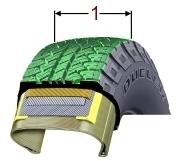
Repairable area
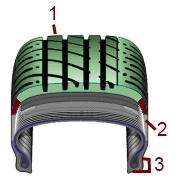
Tyre construction
1. Tread Area
2. Sidewall
3. Bead
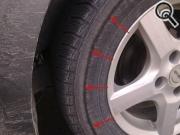
Damage due to driving whilst underinflated